According to the scientific evidence, up to 30% of treatments aimed at removing so-called leg spider veins can end in skin pigmentation that is certainly not satisfactory cosmetically (European guidelines for sclerotherapy in chronic venous disorders. Phlebology Journal 2014;29(6):338–354).
Diagnose before treating
The first step to avoid this complication is a proper diagnostic assessment, which must start from a detailed collection of the patient's clinical history. A high-resolution duplex ultrasound of both legs must then be performed, assessing the whole venous circulation in detail, both deep and superficial.
In fact, in 26% of the apparently purely cosmetic cases, a careful diagnostic examination reveals alterations of the deeper venous system (Telangiectasia in the Edinburgh Vein Study: epidemiology and association with trunk varices and symptoms. Eur J Vasc Endovasc Surg 2008;36:719–724). Failing to identify deep vessels, invisible to the naked eye but responsible for “feeding” the more superficial and visible ones, inevitably leads to a failed cosmetic result in the treated leg.
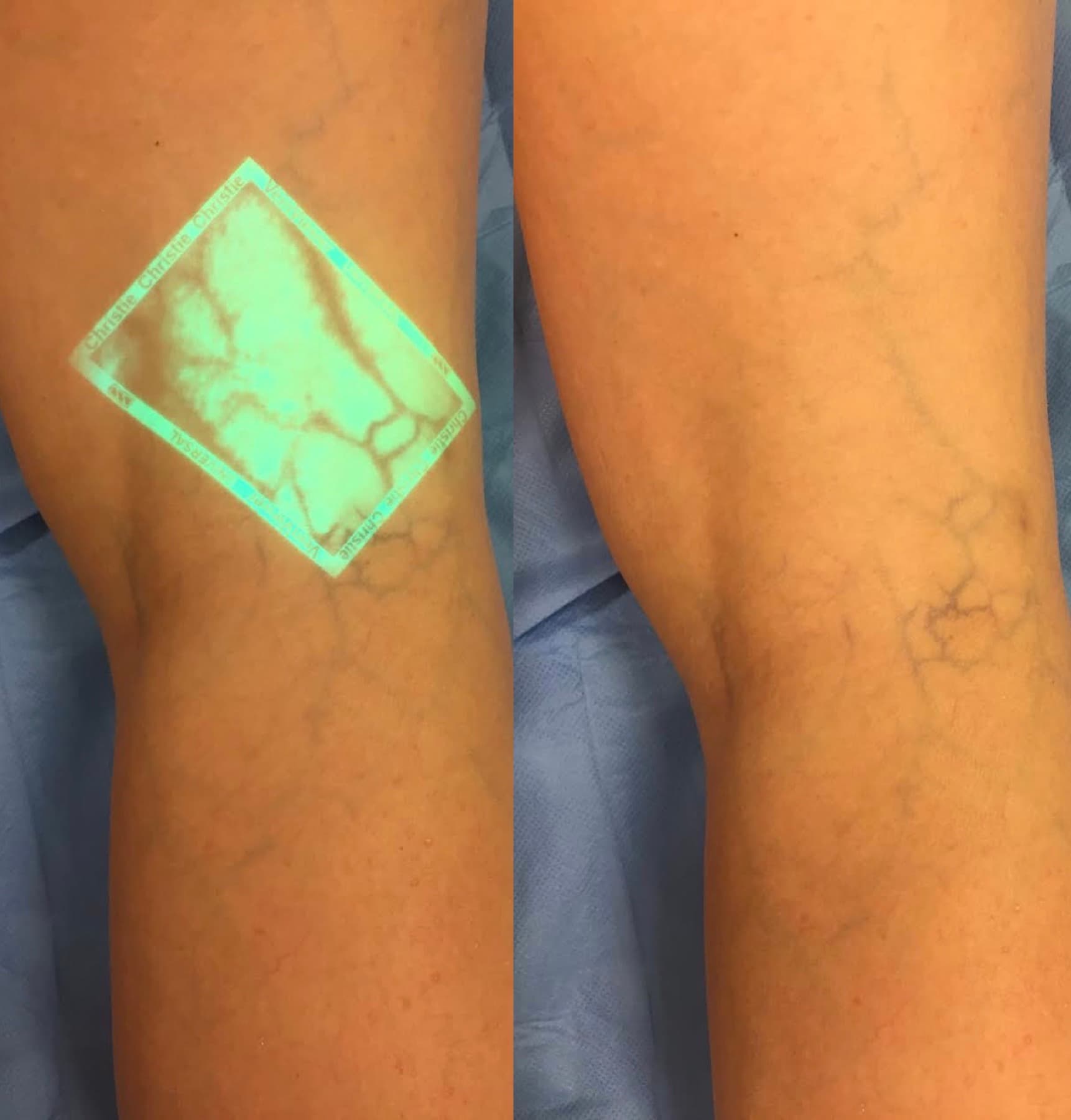
In order to visualise the veins that “feed” the superficial vessels from deep inside the leg, beyond duplex ultrasound it is essential to scan the whole area with so-called transillumination devices and/or augmented-reality visualisers (Clinical practice guidelines of the Society for Vascular Surgery and the American Venous Forum. J Vasc Surg 2011;53:2S-48S). This analysis can reveal vessels visible neither to the naked eye nor on ultrasound, because their calibre is very small.
Sclerotherapy and laser
Many strategic and technical alternatives are available today to remove these blemishes. At the same time, those strategies and techniques have different indications, each dedicated to a different type of vein.
Sclerotherapy remains the most frequently used tool to remove spider veins, particularly when the vessel is larger than 1 mm (Comparative study in leg telangiectasias treatment with Nd:YAG laser and sclerotherapy. Lasers Med Sci 2019). It is, however, also one of the techniques that demand the most experience and mastery, being as effective as it is operator-dependent. The physician has to choose the right agent, the right liquid or foam form, the right concentration, the right injection volume, the right syringe, the right needle, the right angle of entry into the vessel, the right infusion pressure and, above all, the right injection site.
For vessels under 1 mm in diameter, the most recent literature has shown that transdermal lasers can be an option, where the vessel is not too deep and the venous flow feeding the spider vein is not too intense (Comparative study in leg telangiectasias treatment with Nd:YAG laser and sclerotherapy. Lasers Med Sci 2019). When using the laser, particular attention must be paid to the patient's skin colour, since the presence of melanin can significantly change the absorption of the emitted energy, risking permanent hyper- and hypopigmentation.
The laser too demands considerable experience from the operator. Here as well many parameters can be adjusted from case to case, making the result more or less satisfactory: emitted wavelength, energy per unit of surface, area of the energy beam, distance between emission points, pulse duration and, above all, the anatomical site where the treatment is carried out.
What to expect
Contrary to what patients too often believe, the laser is not a magic pen able to erase the blemish instantly. Skin changes such as post-treatment erythema are to be considered normal and most often transient. Follow-up visits are therefore mandatory, to check the outcome of the treatment and to act early on any complication.
In conclusion, the cosmetic treatment of spider veins should dispel the myth of an immediate and easy solution within reach of any physician with minimal experience of sclerotherapy and/or laser. Equally, the belief that cosmetic treatment of spider veins is ineffective because “they come back anyway” is just as wrong when set in a centre with specialists dedicated to these procedures.
Given that every cosmetic procedure is inevitably destined not to last forever, as age advances for everyone, a proper approach to spider vein treatment can deliver a significant result. That cosmetic improvement will depend largely on the physician's skill, and to a lesser extent on how far the patient follows the advice and lifestyle guidance the professional has explained.
A proper cosmetic treatment has to look after the patient in the round, following them with the utmost professionalism before, during and after the procedure. Only with this thorough coverage of every aspect related to the treatment can the blemish be made to disappear effectively.