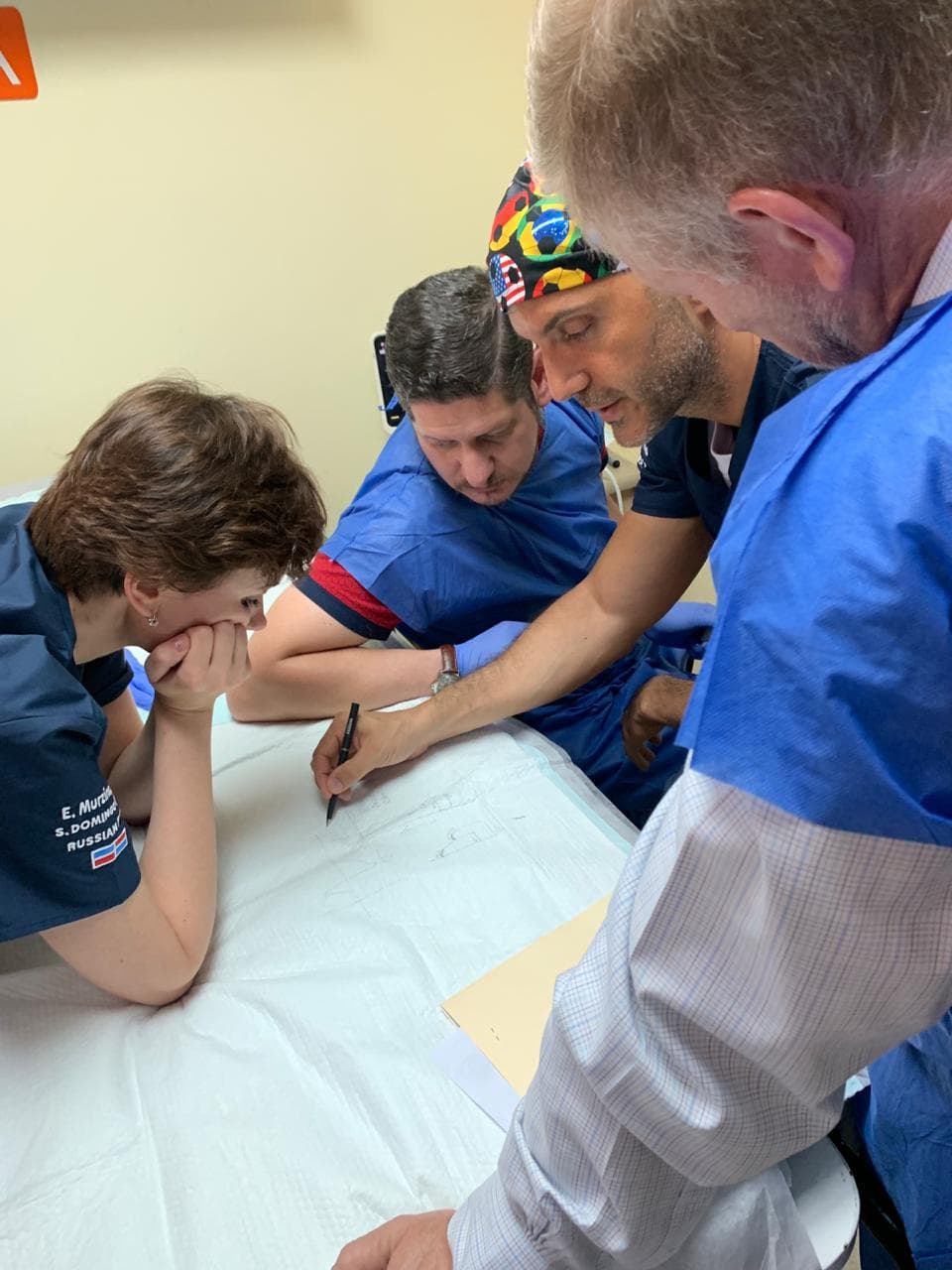
Last July the humanitarian medical and educational campaign organized by Prof. Sergio Gianesini, in his capacity as president of the venous-lymphatic World International Network foundation, was successfully concluded in the Dominican Republic.
The initiative involved, as tutors, 14 leading international experts in the venous field, coming from every continent and from prestigious universities. The non-profit medical activity benefited 315 Dominican patients without financial means and affected by severe venous insufficiency of the lower limbs. Beyond the humanitarian aspect, there was the educational one for the benefit of 74 Latin American physicians, now trained in the most modern and effective techniques for the treatment of varicose vein and ulcer disease.
During the clinical activities, educational videos were recorded in English and Spanish and will soon be available free of charge to all interested physicians.
To complete the educational activities, medical lectures were held at the local university with the direct involvement of students and residents.
Not least, the local population had the opportunity to be properly informed about the high frequency and potential severity of varicose vein disease thanks to a walk/run enriched by educational banners carrying medical advice based on scientific evidence.
Chronic venous disease of the lower limbs, more commonly known as varicose vein disease, is an extremely widespread condition in our population, affecting up to 56% of men and 60% of women (Robertson L. Phlebology J 2008;23(3):103-11).
Up to 2% of the population reaches the most severe stages of the disease, thus suffering from skin ulceration associated with venous hypertension: a condition capable of impairing quality of life as much as chemotherapy treatment. The epidemiological scale of the disease is such that it absorbs up to 1% of public healthcare spending in industrialized countries (Ma H. J Vasc Surg Venous Lymphat Disord. 2014 Oct;2(4):355-61).
On the other hand, thrombotic venous disease (occlusion of a vein by a clot) remains one of the leading causes of preventable death in industrialized countries (Wendelboe AM et al. J Thromb Haemost. 2015 Aug;13(8):1365-71). The sequelae of venous thrombosis, such as the so-called “post-thrombotic syndrome” and chronic pulmonary hypertension, are serious and often under-treated chronic complications that are potentially preventable through adequate treatment of the acute disease (Sharifi M. Vascular disease management 2014;11(1):E2-E11). In the scientific literature on thromboembolism, the data show that prevention is frequently inadequate (Deheinzelin D et al. J Thromb Haemost 2006;4:1266e1270). Public spending associated with the management of post-thrombotic syndrome alone reaches up to 81% of the budget dedicated to thrombotic disease: this indicates that 81% of the public spending devoted to a disease is consumed by a potentially preventable condition (Aneel A. J Thromb Thrombolysis. 2009 Nov; 28(4): 465–476).
In 2015, one of the most important journals in the field, The Lancet, published a genuine “call to arms” inviting vascular specialists worldwide to commit themselves to increasing public and healthcare awareness of venous disease (http://www.thelancet.com/pdfs/journals/lanhae/PIIS2352- 3026(15)00202-1.pdf).
In that same year, 2015, Prof. Gianesini, in synergy with various national and international specialists, launched a series of non-profit educational and clinical initiatives dedicated to this important purpose.
The experience that has just ended is only one of the various activities carried out, while other similar ones are planned for the immediate future and are entirely aimed at educating both physicians and the general population.